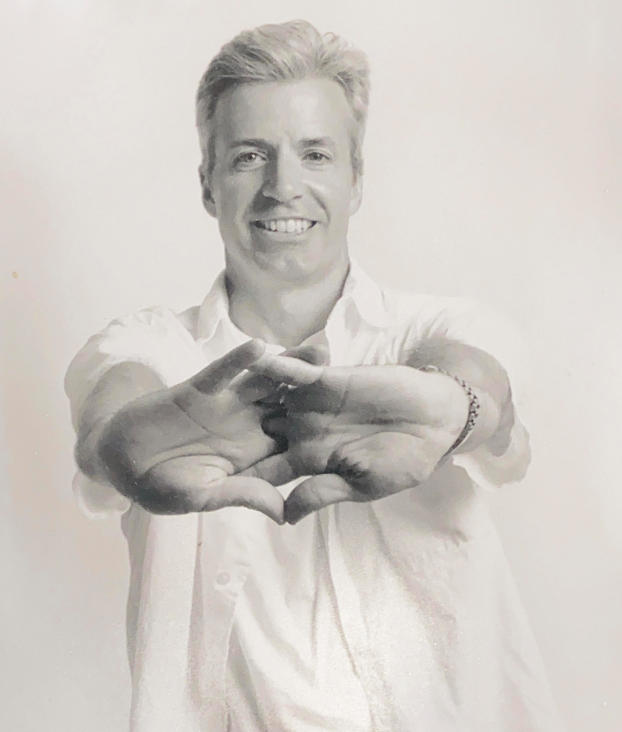
Raised in Tribute:
$20939.75Within three days of Marty passing, we made arrangements to have the hospital bed taken away; the wheelchair returned to a friend who lent it to us; the walker donated to the local Lions Club. It was as if we had erased Parkinson’s Disease that had lived with our family for the past 19 years. What remained in our home were still lots of reminders of Martyness: his sketches of the ‘Scenes of Springs, East Hampton’ he had framed and hung in our tv/hang out room, an oversized Jacques Tati poster for ‘Mon Oncle’, a large papier-mache cow he bought at the Lambertville flea market. His favorite mug hangs in our cupboard and his iconic collection of ties swing on the inside of his side of the closet whenever the door is opened.
This is a Tribute Page, and we have received countless emails and texts and LinkedIn posts of how Marty touched so many people. The words that come up repeatedly have been: creative, intelligent, curious, thoughtful, iconoclast, snappily-dressed, mentor, ahead of his time, fearless, inclusive, humble, and most often, kind.
Marty was my husband, the father of my two [wonderful] children, my best friend, my soulmate and I miss him profoundly. But I lost Marty years ago. Parkinson’s took away his ability to perform simple math, complete basic tasks, write, read, understand a plot line of a movie, and then, over time, speak or communicate even on a primal level. Eighty percent of Parkinson’s patients suffer from dementia, so on top of the falls - of which he had many even with 24/7 care - he would wander at night, try to leave the house, hallucinate, take off his clothes and ‘want to go home.’
Parkinson’s has no cure. Parkinson’s has no recognizable, marked progression because each person suffers on a different timeline. Neurologists can’t answer how long a stage will last in order to help a caregiver prepare for the next step down. We all wait for ‘the shoe to drop,’ terrified of ‘the wolf at the door,’ all the while on orange alert for the debilitating fall.
Initially we did not tell anyone about Marty’s diagnosis except for very close family. New York City is not a place to be vulnerable in the business world. He quietly shrugged when a holiday party guest teased that he had drank too much because he couldn’t slide into his jacket easily. This was just another minor inconvenience at the beginning of the disease, like trying to get out a MetroCard from a leather wallet, when there is a window or ‘honeymoon’ period of still being able to maneuver in the world. Marty stretched, meditated and exercised every morning in order to function at his job. He quipped, ‘It takes me two hours a day to have Parkinson’s.’ As the disease progressed from annoyance to something to be reckoned with, he said, ‘I now know what it means to ‘struggle’ with Parkinson’s.’ And then, one heartbreaking day when he had stop on the sidewalk, sit on someone’s stoop to rest before trying to make it one more block home, he looked at me and said, ‘I wish I could have just one day without Parkinson’s.’
That was the closest he ever came to complaining, so I would add ‘stoic’ to his list of adjectives.
The Michael J Fox Foundation is dedicated to finding a cure for Parkinson’s disease. Their website states that the Foundation leverages its core values of ‘optimism, tenacity, collaboration, boldness, adaptability and curiosity in problem-solving to work on behalf of the 6 million people worldwide living with Parkinson’s.’
I could add those values to describe Marty too but at this point he would be too embarrassed to accept all this praise.
#ilovemarty
The Michael J. Fox Foundation is dedicated to finding a cure for Parkinson's disease and to ensuring the development of improved therapies for those living with Parkinson's today. The Foundation is the world's largest nonprofit funder of Parkinson's research, with more than $2 billion in high-impact research funded to date.
Get Involved